
Table of Contents
ToggleAbstract
The current position of emerging digital technologies on the technology S-curve makes this the right time to invest and innovate. There is a growing consensus that these technologies are still five to ten years away from full maturity and large-scale adoption. This makes ‘now’ an ideal time for organizations to build a strong innovation-driven entry into this evolving space.
By combining data-driven use cases with advantages such as immutability, distributed architecture, concurrency, and enhanced security, early movers can gain significant long-term benefits as these technologies mature. An integrated TMO (Technology, Market, and Organization) approach provides a strong framework for entering this space. A well-executed strategy will not only help organizations establish leadership in this emerging domain but also build capabilities for the future.”
Introduction
Achieving ambidexterity is key to long-term, sustainable competitive advantage for organizations. As technology continues to evolve at a rapid pace, it is critical for organizations to balance their ‘explore’ and ‘exploit’ initiatives to remain relevant in the market.
Emerging digital technologies, still in their early stages, promise to transform the way organizations and individuals access, consume, and interact with data—much like how cloud computing revolutionized data storage. Leveraging these technologies for ambidexterity creates new opportunities for data-driven organizations to innovate across adjacent technologies and markets.
Emerging Technologies as a Disruptor
Managing data in a secure, practical, and flexible way has long been a major challenge for businesses. The rise of the internet, e-commerce, and social media has exponentially increased the availability of data. When effectively analyzed and utilized, this data can provide a lasting competitive advantage to organizations. From better understanding customers to enabling secure transactions, streamlining processes, and minimizing fraud, the use cases for data-driven businesses are extensive. Effective utilization of available data (or “big data”) remains a key priority for organizations. As technology advances and more devices become interconnected through the Internet of Things (IoT), both the complexity of data and the need for efficient data management will continue to grow.
In its simplest form, modern distributed data technologies enable validation, tracking, and recording of transactions and asset ownership without relying entirely on centralized control. Originally developed to support digital transactions, these technologies have now attracted interest across a wide range of applications. Key features include strong data integrity, transparency, security, and automation, making them suitable for diverse use cases such as digital asset transfers, supply chain traceability, financial transactions, automated agreements, licensing, payments, and IoT ecosystems. These applications span industries including finance, government, communications, pharmaceuticals, high-tech, and natural resources.
As adoption increases, market projections indicate significant growth potential for such technologies, with strong interest from both emerging startups and established enterprises. This highlights their broad applicability and long-term value creation potential.
In many ways, these emerging technologies appear to follow patterns similar to those described by Paul Geroski in The Evolution of New Markets, aligning with historical trends observed in the development of the internet and computing industries.
- “Haphazard and varied development of the initial group of products or services.
- Killer apps that emerge from a large variety of competing products.
- A slow development of the market followed by a breakout and then a rapid uptake of technology.”
As emerging distributed technologies have evolved over the past decade, there are clear signs of multiple adoption patterns playing out. Like many of their technological predecessors—such as mobile phones, personal computers, and social media—these technologies appear to follow the technology S-curve, characterized by an initial slow ‘waiting phase,’ followed by a rapid ‘takeoff’ phase, and eventually a ‘levelling-off’ stage
Participants along this S-curve can be categorized as innovators (early digital asset pioneers), early adopters (new-age digital platforms), and early majority (large enterprises, technology providers, consultancies, and system integration consortiums). Adoption by the late majority and laggards is still in progress.
From another perspective, recent industry analyses place these technologies in the ‘trough of disillusionment’ within the hype cycle of emerging technologies, indicating a phase where initial expectations are being recalibrated before broader, more practical adoption.
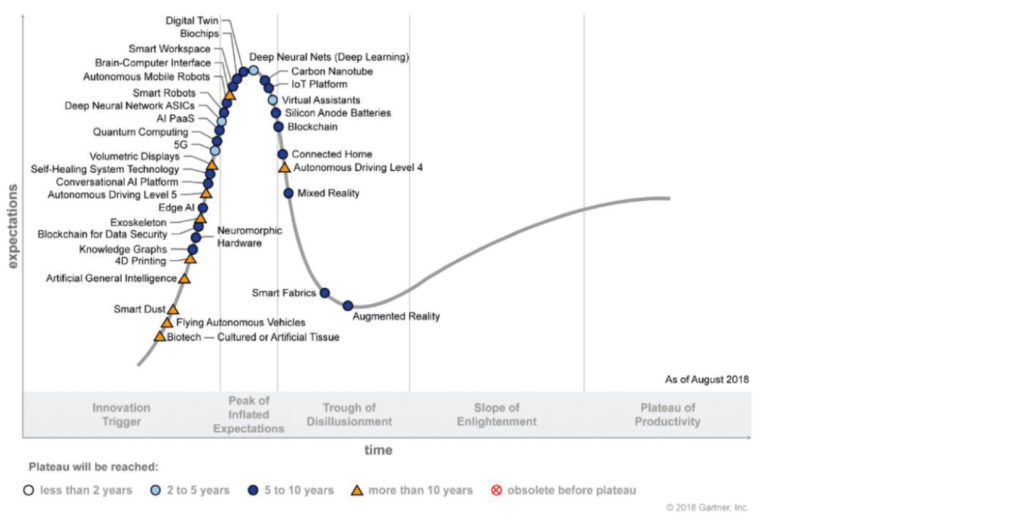
Source (Industry Reports, 2018)
Aligned with the Geroski S-curve, the ‘trough of disillusionment’ in the technology hype cycle represents the third phase of a technology lifecycle, where providers either consolidate or exit, and investments continue through incremental improvements to existing solutions. In the same context, industry reports estimate that these emerging technologies are likely to reach maturity within the next decade. These trends and findings support two key hypotheses about their evolution:
- These emerging technologies have moved beyond the initial phase of hype, with tangible benefits now becoming increasingly visible through real-world adoption.
- As early-stage experimentation stabilizes and the technology continues to mature, this is an opportune time for organizations to invest with a long-term perspective, aiming to realize value over the next five to ten years
Innovation Led by Emerging Technologies
Organizations making an aggressive, determined, innovation-led foray into data-driven industry segments through next-generation technology-driven offerings stand to benefit from the current position of these technologies on the S-curve. Given the present stage of evolution, an integrated Technology–Market–Organization (TMO) approach, with a focused strategy across each of the three pillars, can provide a strong pathway for success in this space.
Furthermore, adopting a hybrid open/closed innovation model to accelerate the development of products and services can help organizations fully leverage the potential of these technologies.
Integrated TMO model
A dynamic TMO framework is well suited for driving a definitive push into emerging technology domains within organizations. While applying this model, it is important to recognize that for innovation to have the greatest impact, it must occur at a platform level rather than being limited to individual products, components, or business units.
This approach is similar to new-generation companies like Apple Inc., which have achieved significant success by building and controlling integrated platforms. By viewing technology, organization, and markets holistically, organizations can identify the right intersection aligned with their strategic identity and operational boundaries.
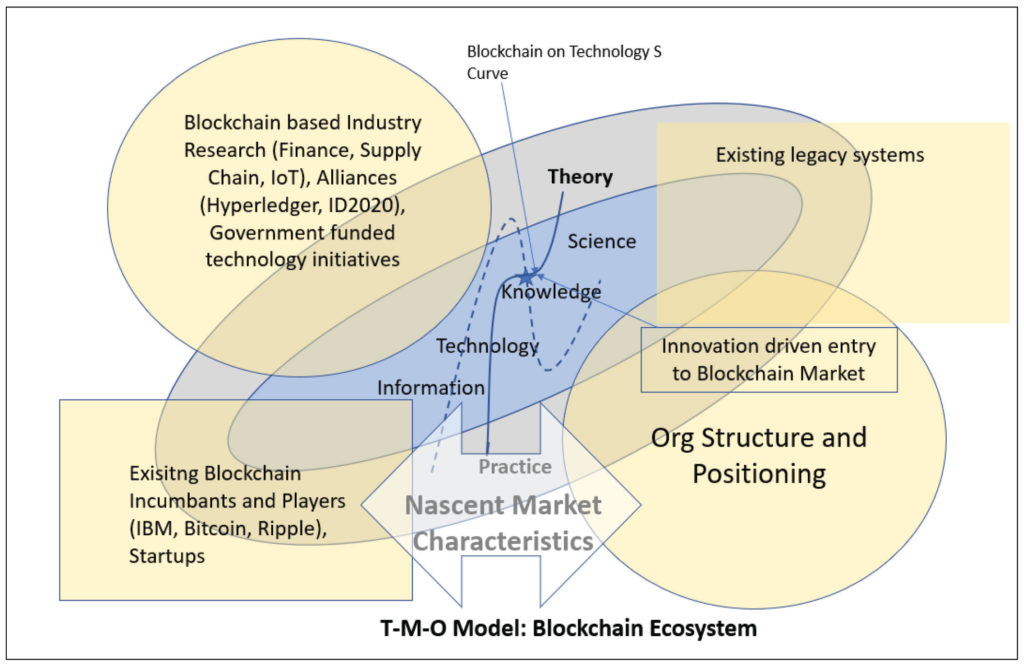
Technology
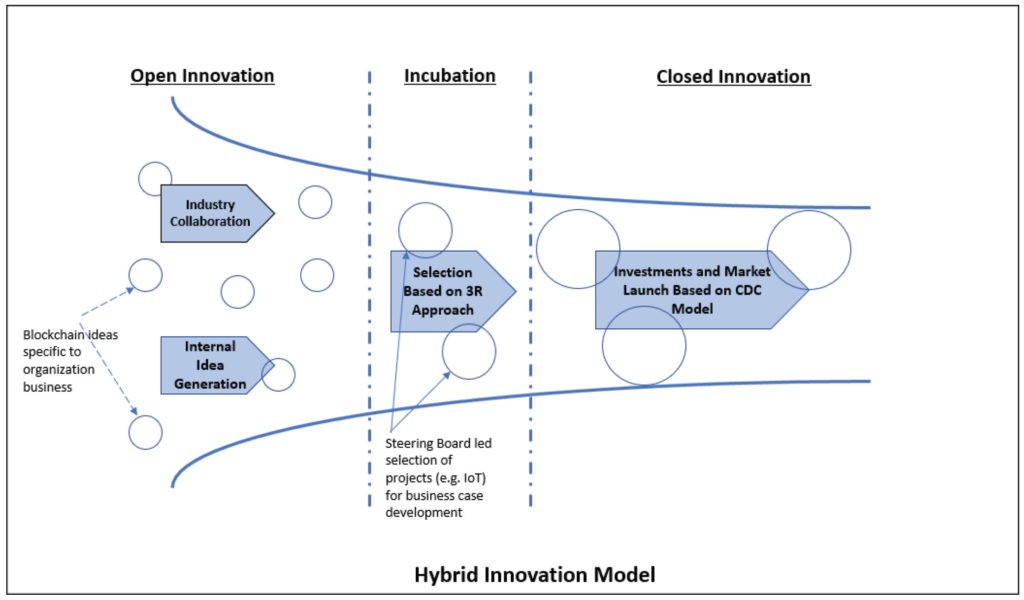
On the technology front, organizations should develop their own innovation approach by combining the strengths of both Open Innovation and Closed Innovation models. Idea generation and early-stage incubation should be encouraged through open innovation by engaging specialized data-driven groups, universities, associations, and user communities. An example of such collaboration models is the Hyperledger consortium. Open innovation should be institutionalized so that insights and developments can be shared across different business units within the organization.
While idea generation takes place within an open innovation ecosystem, high-potential ideas that require focused investment should be advanced through a closed innovation approach. This ensures alignment with industry priorities while maintaining competitive advantage. The transition from open to closed innovation should follow an ‘act fast – fail fast’ mindset, similar to IDEO’s “Three R’s” approach: “Rough, Rapid, Right” and “Enlightened Trial and Error.”
Drawing inspiration from IBM’s innovation jams, and their implementation by Siemens, organizations can establish their own web-based innovation platforms. To ensure focus and relevance, these initiatives should center around key themes such as supply chain traceability, digital product passport (DPP), and data-driven transformation.
Such innovation programs enable cross-functional collaboration, allowing participants from different business units to move beyond siloed thinking. Over a defined short period (typically one to two weeks), participants can contribute ideas and engage in discussions, leading to the emergence of structured insights through tagging and collaborative exchanges. Siemens successfully implemented this approach through its TechnoWeb 2.0 platform, enabling effective idea generation and knowledge sharing across the organization.
Market
In many ways, emerging data and supply chain technologies exhibit characteristics of a nascent market, despite having existed in various forms over the past decade. Like most nascent markets, this space is marked by an undefined industry structure, unclear or evolving product definitions, and the absence of a dominant logic to guide strategic actions. One of the most defining characteristics of such markets is the high level of ambiguity, where the lack of established norms makes it difficult to interpret trends and outcomes with clarity. The entry of new firms further adds to this complexity, often bringing fluid organizational structures and evolving business models. This makes it essential for organizations to clearly define their strategic boundaries based on their identity and core strengths within this emerging domain.
An organization’s entry into this space should follow a well-structured Claiming Demarcating Controlling (CDC) approach. Drawing from identity-based strategies, organizations can establish their presence by adopting familiar frameworks, signaling leadership, and sharing compelling narratives. As organizations invest in pilot solutions and early offerings, their front-end teams can leverage recognizable concepts from adjacent domains to communicate a clear and differentiated identity using intuitive terms such as ‘data platform’ or ‘digital vault.’ At the same time, leadership teams should actively engage with the market to reinforce their positioning, for example by promoting best practices in data management, traceability, and compliance through industry forums and conferences. Additionally, organizations can strengthen their market presence by investing in storytelling highlighting successful implementations and innovations through launches, events, and knowledge-sharing platforms.
While establishing presence is critical, organizations must also focus on demarcating the market to achieve competitive advantage. This involves defining their unique space while building entry barriers and expanding their influence. Strategic positioning, combined with thought leadership and ecosystem participation, can help shape market perception and strengthen credibility. A cohesive approach to claiming, demarcating, and controlling supported by a clearly defined organizational identity will enable organizations to build a strong and differentiated position within this evolving and dynamic market landscape.
Organization
At the organizational level, entering emerging technology domains should be a well-thought-out strategic decision rather than a tactical initiative. The resulting innovation model must align with long-term strategy, rather than relying on routine innovation efforts that can often be short-term and limited in scope.
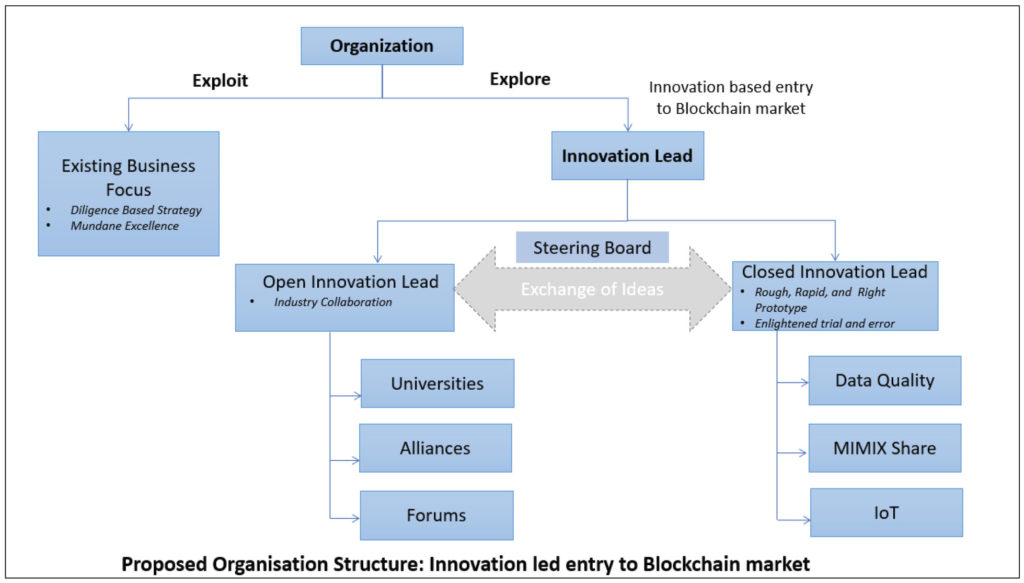
Given the current position of these technologies on the S-curve, the organizational structure designed to support this focus must be sustainable over a period of five to ten years to fully realize the value of investments made today. One effective approach is the formation of two distinct entities or streams—one focused on exploitation (optimizing existing capabilities) and the other on exploration (driving new innovation).
Achieving the right balance between these two streams enables organizations to develop ambidexterity, allowing them to strengthen their current strategy while simultaneously building a strong and forward-looking position in this evolving space. The figure below illustrates a proposed organizational setup to support this balanced approach.
“On the exploit track, organizations should build momentum in their existing operations through a ‘strategy as diligence’ approach. This involves actively sharing activities and resources across divisions as well as newly acquired businesses. In the dynamic technology landscape—where software products increasingly become commoditized—differentiation on the exploit side comes from the ability to seamlessly integrate seemingly simple, routine activities. When combined effectively, these create a strong barrier to imitation and make organizational capabilities distinctive. This form of disciplined execution is particularly valuable for organizations focused on delivering superior customer experience, where everyday practices such as agile stand-ups play a critical role in building sustainable competitive advantage.
While strengthening the exploit side, organizations must also establish a distinct and dedicated focus on the explore track. The organizational structure required to support this approach demands long-term commitment from senior leadership, operational autonomy, and dedicated funding. One possible model is to create a separate explore unit under the CTO, led by a Chief Innovation Officer. Within this structure, innovation initiatives should be divided between Open Innovation and Closed Innovation units.
The Open Innovation unit collaborates with external partners, developer communities, and strategic alliances to bring in new ideas, while the Closed Innovation unit focuses on developing and scaling solutions aligned with the organization’s core capabilities. A governance mechanism—such as a cross-functional leadership committee comprising the CEO, CTO, CFO, and other senior leaders—should regularly evaluate and transition high-potential ideas from open to closed innovation streams.
The explore unit should be tasked with delivering market-ready solutions within defined timelines, ensuring tangible outcomes that demonstrate the organization’s commitment to innovation beyond research initiatives. The emphasis should be on launching solutions that are ‘good enough’ to create early impact, rather than delaying for perfection.
Strategy Execution for the Explore Unit
The most important guiding principle for an innovation-led approach is its potential to create value for customers. Clearly defining the value innovation will deliver and consistently aligning efforts toward that goal is critical, as the capabilities required for future success take time to develop. A useful parallel can be drawn from the approach of Bell Labs, which focused on improving the reliability and capability of telecommunications networks. Through this long-term vision, Bell Labs delivered multiple breakthrough innovations, ranging from telephone switching systems to photovoltaic cells and lasers.
Innovation is often mistakenly used interchangeably with technological advancement. However, to build lasting differentiation in emerging technology domains where multiple players are investing heavily in products and technical capabilities organizations should focus on business model innovation. This approach enables organizations to tap into underutilized sources of value while making it significantly harder for competitors to replicate an entire activity system compared to a single product or process.
A disruptive innovation approach can further strengthen this strategy by challenging existing market structures and redefining value delivery. For example, Google’s Android operating system transformed the mobile ecosystem not purely through technological differentiation, but through a disruptive business model. This shift created new industry dynamics and posed significant challenges to established players like Apple Inc. and Microsoft by introducing a new ecosystem with different rules of competition.
Exploring disruptive business models within areas such as supply chain traceability and Digital Product Passport (DPP) solutions can serve as a strong differentiator, enabling organizations to create sustainable competitive advantage in evolving markets.
Key Considerations
To derive real and tangible benefits from evolving technologies, organizations must adopt a long-term strategic perspective. These technologies may not generate immediate revenue or profits, as the surrounding market and ecosystem are still developing. Therefore, the innovation model built around them should operate with a degree of autonomy and independence to deliver meaningful outcomes. At this stage, such technologies cannot always be seamlessly embedded into every product or project and instead require a focused and dedicated approach for organizations to realize value over the medium to long term. Additionally, several aspects particularly related to business models remain uncertain, making it important for organizations to adopt a milestone-based approach when developing products and services in this space.
These technologies should not be viewed merely as technical initiatives, but as enablers of new ways of doing business. The lack of immediate benefits for non-technical functions should be addressed through a combination of monetary and non-monetary incentives to encourage adoption and alignment across the organization.
Finally, successfully entering this evolving market requires organizational transformation. Change management plays a critical role and is most effective when driven from the top. For such initiatives to succeed, they require strong support, commitment, and long-term vision from senior leadership, which must then be embedded across the entire organization.
Conclusion
Not since the advent of the internet has a category of emerging technologies demonstrated such promise and wide-ranging applications. This is a market characterized by both ambiguity and significant opportunity. The current position of these technologies on the S-curve makes them well suited for organizations to strategically claim, demarcate, and shape this evolving space.
They present a unique opportunity for organizations to leapfrog competitors through well-designed, innovation-led strategies and execution. Achieving lasting competitive advantage will depend on an organization’s ability to differentiate itself in ways that are difficult to replicate or imitate. At the same time, these technologies provide a strong foundation for building long-term capabilities and expertise that can be leveraged across future markets.
References
- Forbes (2018). Top Emerging Technology Companies to Watch. Available at: https://www.forbes.com/sites/andrewrossow/2018/07/10/top-10-new-blockchain-companiesto-watch-for-in-2018
- Albany.edu (2018). Innovation and Design Thinking Approaches. Available at: https://www.albany.edu/faculty/miesing/teaching/materials/IDEO.pdf
- Bitcoin News (2018). Technology Hype Cycle and Market Trends. Available at: https://news.bitcoin.com/blockchain-enters-trough-disillusionmentgartner/
- Hyperledger (2018). Open Source Technology Projects. Available at: https://www.hyperledger.org/projects
- MIT Sloan Management Review (2012). Creating Value Through Business Model Innovation. Available at: https://sloanreview.mit.edu/article/creating-value-through-businessmodel-innovation/
- Finance (2016). Distributed Technology Basics: A Primer. Available at: https://www.finyear.com/Blockchain-Basics-APrimer_a36196.html
- Geroski, P. (2003). The Evolution of New Markets
- Lakhani, K. et al. (2015). Open Innovation at Siemens. Harvard Business School
- O’Reilly, C. & Tushman, M. (2015). Lead and Disrupt
- Nakamoto, S. (2008). P2P Digital Currency Paper. Available at: https://www.mail-archive.com/cryptography@metzdowd.com/msg09997.html
- Pisano, G. (2015). You Need an Innovation Strategy. Harvard Business Review
- Powell, T. (2017). Strategy as Diligence. California Management Review
- Santos, F. & Eisenhardt, K. (2009). Constructing Markets and Shaping Boundaries. Academy of Management Journal
- Talend (2018). Data Integration and Leadership Overview. Available at: https://www.talend.com/about-us/
- Forbes (2018). Major Technology Trends Outlined by Deloitte. Available at: https://www.forbes.com/sites/andrewarnold/2018/07/27/the-6-major-blockchaintrends-for-2018-outlined-by-deloitte/
- Medium (2017). Understanding New Market Formation. Available at: https://medium.com/@marklooi/what-makes-a-new-market-be7925c7b576
- Ventresca & Hajek (2010). Technology-Market Organization (TMO) Framework. Saïd Business School.